You can't really come to Sydney without making a trek up into the iconic Blue Mountains, the most-visited national park in New South Wales.
I first visited the Blue Mountains during a solo backpacking trip around Australia in 2019 where I followed the classic backpacker route, mostly visiting big cities, staying in hostels and traveling by public transport.
This time, I've returned to Australia with my partner and we're currently living full-time in our campervan, a 2018 Mercedes Sprinter, with a plan of "driving the lap" (completing the entire perimeter of the country). We visited the Blue Mountains a few times at the end of our lap of our Australia.
For thousands of years, the Dharug and Gundungurra peoples lived on this land, long before any Europeans arrived.
The Blue Mountains are approximately one million years old. The first European to name them was Governor Phillip in 1788 who called them both Carmarthen Hills and Landsdowne Hills although the name was changed soon after to Blue Mountains because of their colour. The blue colour is thanks to the eucalyptus trees of the mountains which release fine drops of oil. These drops combine with dust and water in the air which show up blue in colour.
The first Europeans to explore the mountains were a small group in 1813 which was recorded as being a constant challenge and nearly impossible. They discovered the "gently sloping mountains" on the western side which were finally seen as the access point. A road was built in 1814 led by engineer William Cox which led to a military outpost established in 1817. A railroad was built, connecting Sydney (Penrith) to the Blue Mountains in 1867 which revolutionized access to the area.
The creation of a national park to protect the area was proposed by conservationist Myles Dunphy in 1932, a decision that was formalized in 1959, then covering just over 160,000 acres. Blue Mountains National Park today stretches over 660,000 acres to protect the Blue Mountains which are a UNESCO World Heritage Site home to countless hiking trails, waterfalls, viewpoints and towns to explore.
→ Learn the complete history of the Blue Mountains.
I first visited the Blue Mountains in January 2019 on a solo backpacking trip and returned with my partner in our campervan in June 2026 and updated the original post with all the new things we did. This post was first published on 12 January 2019; last updated 9 June 2026.
Heading to Australia? Every single spot (and more) that I mention in all my blog posts about Australia (including its three external territories) can be found in my Ultimate Australia Map!
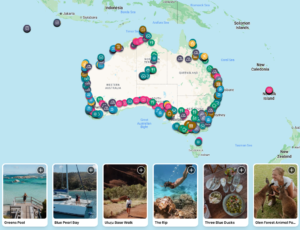
This is a digital map featuring hundreds of my favourite:
- restaurants and cafés
- campgrounds and accommodations
- shops
- photo spots
- museums and galleries
- beaches and lakes
- places to see animals
- bridges and viewpoints
- hikes
- snorkeling spots
- AND SO MUCH MORE!
Each pin includes the exact location (plus the ability to open it directly in Google Maps), lots of photos for inspiration, detailed information to help you visit the spot plus a link to my relevant blog post to read lots more about it.
Below is some useful information for preparing for your trip to the Blue Mountains. In all cases, please be sure to check with the relevant local authorities for the latest and accurate information.
Language: The official language of Australia is English. In the Blue Mountains, the traditional language of the Dharug and Gundungurra peoples is Darug and Gandangara respectively.
→ Learn more about the languages of the Dharug and Gundungurra peoples.
Currency: The currency used in Australia is the Australian dollar, denoted as AUD $. I use a Wise account when I travel which allows me to have a single, free account with multiple currencies. I only have to pay once to convert my money in the app and then I can pay in AUD $!
→ Check the latest currency conversion between AUD $ and your local currency.
Data/WiFi: Before you arrive, I recommend purchasing an eSim on your phone so that you can access data the moment you land. eSims are much more convenient as it means you don't have to put a separate physical Sim into your phone. AirAlo offers great deals for eSims of various data sizes and time lengths with Optus.
→ Load an international eSim on your phone with AirAlo.
If you are visiting Australia long term, you might wish to put a physical Sim in your phone as AirAlo is geared more towards short term visitors on holiday. This way you can access a local phone plan. There are three main mobile phone network providers in Australia: Telstra, Optus and Vodafone. Telstra has the best coverage across the country whereas Optus and Vodafone are good within cities. I recommend Telstra as it means you have the best coverage while you travel around the country, especially in rural areas.
Free WiFi is available at the Blue Mountains Public Library as well as at a number of restaurants, hotels and cafés.
Visa: All passport holders except New Zealand require a visa to visit Australia. All arrivals must fill out an Australian arrival card before landing.
→ Check which visa you need for Australia.
Time of year to visit: Australia can be visited all year-round. The Blue Mountains, west of Sydney in New South Wales, can get very busy in the summer, especially around school holidays, and cool in the winter months. I recommend visiting in spring (September-November) or autumn (March-May) for pleasant, sunny days. We visited in June and it was already very cold!
Length of stay: Across three visits in 2019 and 2026, I've spent about a week in the Blue Mountains. It's a great day or multi-day trip to do from nearby Sydney and is New South Wales' most-visited national park.
By flight: The closest airport to the Blue Mountains is Sydney, Australia's second-largest city and a major travel hub.
By car: If you're driving around the country as we are in our campervan, then the easiest way to get to the Blue Mountains is with your own wheels. The most popular way of exploring Australia is by camping - whether with a motorhome, campervan, caravan or a roof tent on top of a car. This gives you the ultimate freedom of going as fast or as slow as you like.
→ If you don't have your own car, you can rent one in Sydney.
→ Rent a campervan in Sydney with Apollo, Camplify, Indie or Juicy.
It takes about an hour and a half to reach the national park from Sydney.
By public transport: You can get to the Blue Mountains by on the Blue Mountains Train line directly from Sydney Central which means you don't have to deal with busy parking in the national park. The train journey takes about two hours and local buses connect with each station in the mountains to get you where you're going.
→ Plan your trip with public transport to the Blue Mountains.
By guided tour: There are countless guided tour options for exploring the Blue Mountains, either as a day or multi-day trip from nearby Sydney, or once you've already arrived in the area. This is a great option if you don't have your own wheels or simply want to go the guided route.
When I visited the Blue Mountains in 2019, I just did a day trip from Sydney, a popular way of visiting the area if you're short on time. However, if you have time, I can really recommend spending a few nights here in order to be able to properly explore all the different towns and get some hiking in.
Hotel: Not traveling by campervan? Driving in a car? Whatever your reason for needing a place to stay, there are some great accommodation options in the Blue Mountains to suit any budget.
→ Check out all the accommodation options in the Blue Mountains.
Camping: We are driving "the lap" around Australia, exploring the country in our campervan. The best way to find legal camping spots is to use an app. We use Wikicamps Australia, a cheap app that has every single amenity listed (both free and paid) that you might need on the road. This includes things like where to fill up fresh water, where to dump grey water, where to empty toilets, where to stay, gas stations, information points and also has suggestions for things to do as you go.
→ Download the Wikicamps Australia app.
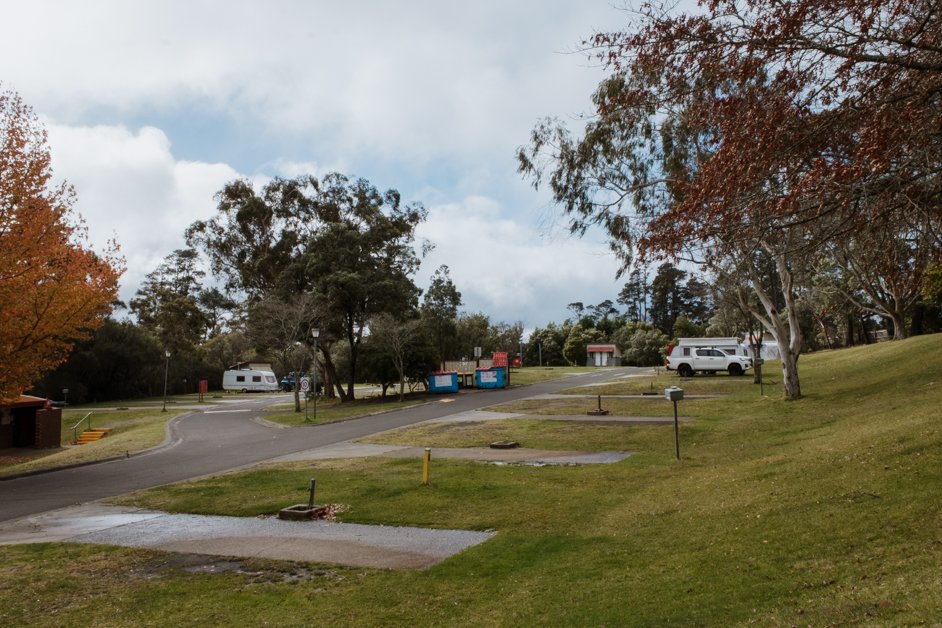
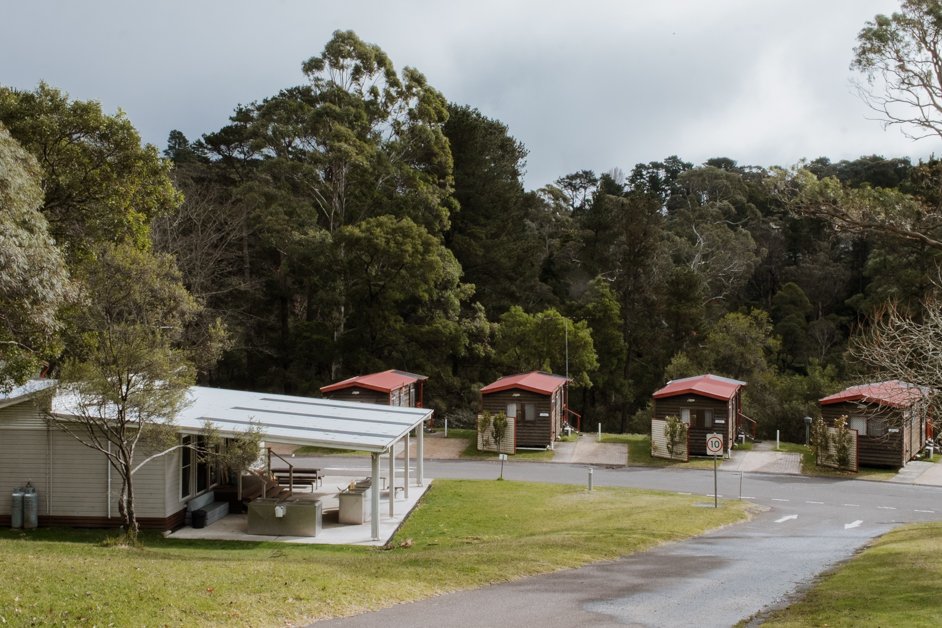
We visited the Blue Mountains a few times from Sydney at the end of our lap of Australia. Blackheath Glen Tourist Park is a lovely little paid campsite in Blackheath, one of the northernmost towns of the Blue Mountains area. The staff were great and best of all, unlimited steaming hot showers after cold days in the mountains.
There are a number of different towns in the Blue Mountains to explore. Katoomba is the biggest and most popular but be sure to get out and visit the others, too!
In Blackheath, we had a simple but yummy dinner at Blue Mountains Sushi. It was quiet, low-key and great.

Blue Mountains Sushi
When I visited the Blue Mountains in 2019, I just did a day trip from Sydney, a popular way of visiting the area if you're short on time. However, if you have time, I can really recommend spending a few nights here in order to be able to properly explore all the different towns and get some hiking in.
See the Three Sisters
The Three Sisters is the most famous landmark in the entire Blue Mountains area and therefore very popular.


Echo Point
Hike to Wentworth Falls
Difficulty: intermediate
Length: hiking to Wentworth Falls and returning on the Charles Darwin Walk takes approximately an hour to complete the loop
Directions: from Wentworth Falls Station, walk down Falls Road to begin the hike, following signs for Wentworth Falls; return via the Charles Darwin Walk

Wentworth Falls


BOOK AN EXPERIENCE IN THE BLUE MOUNTAINS!
PIN THIS POST TO REFER BACK TO LATER!
GET READY TO TRAVEL!
— Book tours and experiences - with GetYourGuide
— Get all the gear you need for your trip - with Amazon (North America)
— Get all the gear you need for your trip - with Amazon (Europe)
— Find a place to stay - with Booking.com
— Choose a hostel to stay at - with Hostelworld
— Purchase global travel insurance - with World Nomads
— Load an international eSim on your phone - with AirAlo
— Start your own travel blog - with Hostinger
— Join the GetYourGuide Travel Creator Community - with GetYourGuide
Discover more from Jana Meerman
Subscribe to get the latest posts sent to your email.

Hi! I’m Jana, a Dutch-German-British-Canadian with a dream of seeing every country in the world. I am a storyteller, photographer and adventurer passionate about documenting and sharing my travels.